The One-Mile Walk Survives Because There Is No Believable Excuse
Quick Answer: Habits break at the moment of internal negotiation, not at the moment of effort. A one-mile walk takes 15-20 minutes and defeats nearly every excuse available, which is why it survives weeks that destroy larger plans. The consistency is the mechanism, not the distance.
You have started and abandoned bigger plans repeatedly. The mile sounds too small to matter, which is precisely the property that makes it work.

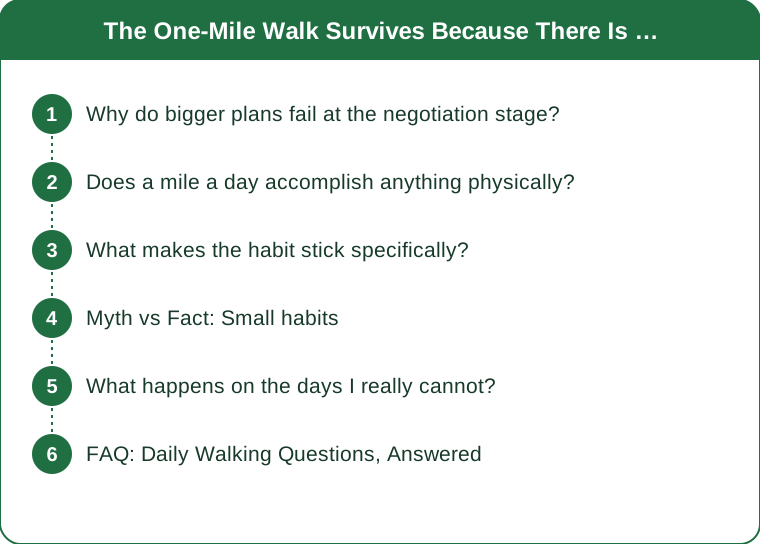
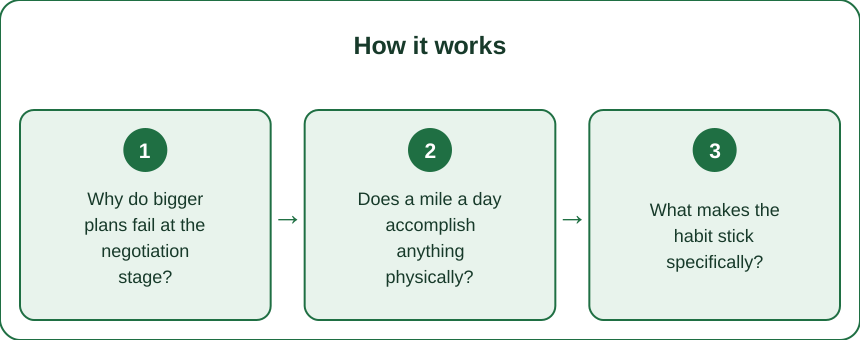
Why do bigger plans fail at the negotiation stage?
Every planned session generates an internal argument at some point: is this happening today or not.
The strength of the counterargument scales with the size of the ask. A 60-minute session invites reasons: no time, too tired, weather, other obligations. Each reason is individually reasonable.
A 15-minute walk invites almost none. There is no credible version of not having 15 minutes, and that lack of a believable excuse is doing the actual work. You are not out-disciplining the excuse; you are removing its material.
Does a mile a day accomplish anything physically?
More than people expect, and less than a training plan.
A mile is roughly 2,000 steps, 15-20 minutes, and 60-100 calories depending on pace and body size. Daily, that is 14,000 steps a week added to whatever else you do.
The research on light activity is consistent that moving from sedentary to lightly active produces the largest health returns of any step on the curve. The gap between 3,000 and 5,000 daily steps matters more than the gap between 9,000 and 11,000.
So for someone currently sedentary, a daily mile is genuinely meaningful. For someone already active, it is a floor rather than a program, which is still worth having.
What makes the habit stick specifically?
Three properties, and all three matter.
It is time-bounded. You know exactly what you are agreeing to, so there is no open-ended dread.
It has a fixed trigger. Attached to an existing routine, after dinner, after the morning coffee, it does not require remembering.
It has no performance dimension. There is no pace to hit, so there is no bad session. Nothing to fail means nothing to avoid.
Remove any one of these and the habit gets noticeably more fragile. The pace-free property is the one people accidentally destroy by adding a tracker goal.

Myth vs Fact: Small habits
Myth: Small habits naturally grow into big ones. Fact: sometimes, and expecting it is what kills them. Treat the mile as permanent, not as a starter step.
Myth: If it is easy, it does not count. Fact: adherence dominates outcomes at low volumes. Something done 300 days a year beats something better done 40 days a year, comfortably.
Myth: You should track it to stay accountable. Fact: tracking helps some people and adds a failure surface for others. If missing a day on a streak app makes you quit entirely, do not use one.
Myth: The mile has to be continuous. Fact: split it if needed. Two half-mile walks produce nearly the same benefit and are even harder to argue with.
What happens on the days I really cannot?
You do a shorter version, and you do not skip.
The rule that keeps this alive long-term is never zero. Five minutes around the block on the worst day preserves the habit’s structure, which is worth far more than the five minutes of walking.
Skipping entirely is what starts the erosion, because the second skip is much easier than the first. Keeping a floor, however small, means there is never a first skip to build on.
Late summer is the easiest possible time to establish this, with long evenings and mild weather. Build it now and by the time it is dark at 5 pm, it is already automatic rather than a new thing you are trying to start in the worst conditions of the year.
FAQ: Daily Walking Questions, Answered
Does pace matter?
Not for the habit. For fitness, a brisk pace where talking is possible but singing is not gives more benefit, and it is a fine upgrade once the habit is stable.
Morning or evening?
Whichever attaches to a routine you already have reliably. Consistency of trigger matters more than time of day.
Is a treadmill mile the same?
For the habit, yes. Having an indoor option is what keeps it alive through weather, which is the main failure point after month two.
TL;DR:
- Habits break at the negotiation stage, and a mile leaves no believable counterargument
- 2,000 steps daily is genuinely meaningful for anyone currently sedentary
- Keep it time-bounded, trigger-attached, and pace-free, or it gets fragile
- Never zero: a five-minute version on bad days protects the whole structure
Pick the routine you never skip, coffee, dinner, closing the laptop, and attach the mile to it starting tonight. The trigger is what you are actually installing; the walking is almost incidental.
See It in Motion
Seen here: High Waist Yoga Leggings with Inner Pocket — shop it on bubblelime.com
Keep Reading
This article is for general informational and styling purposes only. Fit, sizing, and product availability may vary.