Why Does the First Quarter Mile Decide How the Whole Mile Feels?
Quick Answer: The opening two to three minutes of a mile are when your cardiovascular system is still catching up to your muscles, so effort feels artificially easy — and most people respond by walking faster than they can hold. Your brain then calibrates its sense of normal to that opening pace, and the remaining three quarters feel harder than they are because they are being compared to a pace you were never going to sustain.
The mile did not get harder in the third quarter.
The first quarter set you up.
This is general information, not medical advice.

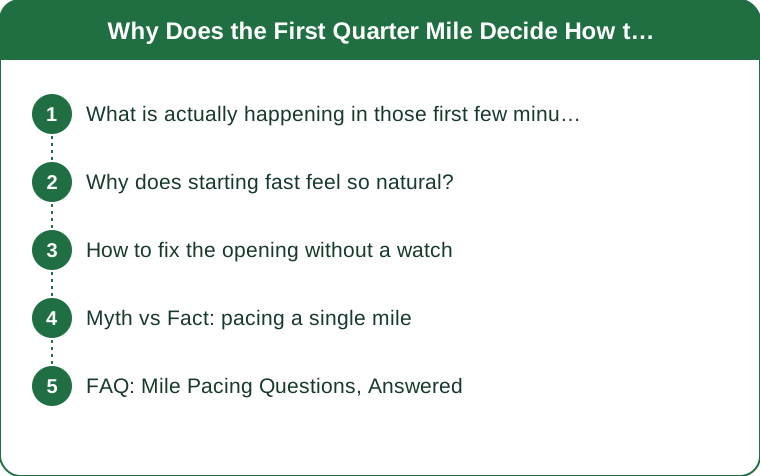
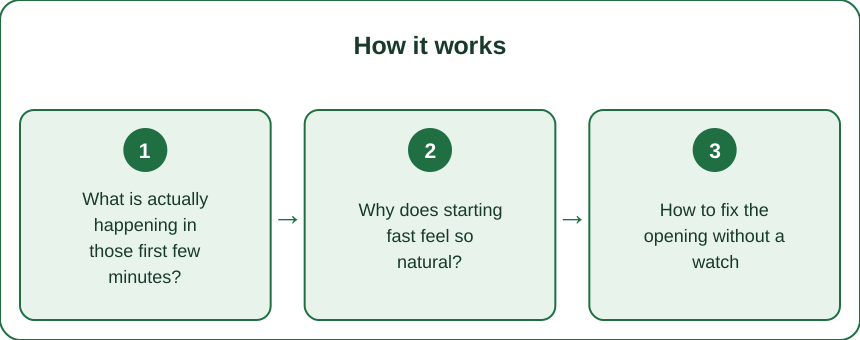
What is actually happening in those first few minutes?
Your muscles are ready before your delivery system is.
When you start walking, the working muscles begin using oxygen almost immediately, but heart rate, breathing rate, and blood flow redistribution take a couple of minutes to catch up. During that window you are running partly on stored energy that does not require the full system to be online yet. It feels easy because the bill has not arrived.
Then it arrives. Heart rate climbs, breathing deepens, and the pace you chose in the easy window is suddenly the pace you have to defend.
There is a second thing happening at the same time, and it is the one people miss. Your brain is building a reference point. Perceived effort is relative, not absolute — it is constantly comparing now to a moment ago. If the opening felt effortless, the middle feels disproportionately hard even when it is objectively moderate.
So the same mile, walked at a genuinely steady pace throughout, is experienced as easier than a mile that starts fast and settles. Same distance, same average speed, different story.
Does this apply to walking or only running?
Both, and it is arguably more noticeable in walking. Walkers rarely warm up, so the whole adjustment happens inside the walk itself.
Why does starting fast feel so natural?
Because everything about the start encourages it.
You are fresh. Legs feel light, nothing aches yet, and the effort signal has not caught up. The natural response to feeling good is to go faster.
The start is usually the least interesting part of the route. Most people’s opening quarter is the stretch nearest home — familiar, unremarkable, and something to get through. Boredom raises pace without you deciding to.
You are often slightly late. A walk squeezed between other things starts with the residue of hurry still in your body. The pace of the last five minutes carries over.
Cool air makes it worse. As the mornings turn, the first minutes feel crisp and pleasant, and cool air suppresses the early warmth that would otherwise signal you to ease off. Autumn is the season people most reliably start too fast.
None of these are errors of judgement. They are the default, which is why the fix has to be deliberate rather than intentional-in-general.
Is starting fast ever useful?
In a short race where the distance is over before the cost lands, yes. Over a mile walked for fitness or clear-headedness, it reliably makes the experience worse without making it faster.

How to fix the opening without a watch
You do not need pace data. You need one constraint that makes the opening slower than it wants to be.
Count the first sixty steps. Deliberately take your first minute at a pace where you could carry on a full conversation without pausing for breath. It will feel absurdly slow. That is the correct sensation.
Use a landmark, not a time. Pick something roughly a quarter of the way in — a particular corner, a postbox, the second crossing — and treat everything before it as warm-up rather than walk. Arriving at it feeling like you have barely started is the goal.
Breathe through the nose for the first three minutes. This is the simplest self-limiting device there is. Nasal breathing caps your pace at somewhere near a genuinely easy effort, and when you naturally want to open your mouth, you have found the ceiling.
Start uphill if your route allows it. A gentle climb at the beginning enforces a slower opening for free, and the descent later comes when you are warm.
Let the second half be the fast half. If you want to finish quickly, finish quickly. A mile walked slow-to-fast almost always feels better and often ends up faster overall than the reverse.
How much slower should the opening actually be?
A useful rule of thumb: if the whole mile is your normal brisk pace, the first quarter should feel like the pace you would walk with someone carrying a full cup of coffee.
Myth vs Fact: pacing a single mile
Myth: A mile is too short to need pacing. Fact: A mile is exactly long enough for a bad opening to ruin it and exactly short enough that you cannot recover the experience. Longer distances give you time to settle; a mile does not.
Myth: If it feels easy, you should go faster. Fact: Early in any effort, easy is not information — your system has not caught up yet. Feeling easy at minute eight means something. Feeling easy at minute one means nothing.
Myth: Warming up is only for runners and gym sessions. Fact: A warm-up is just the beginning of the activity done more slowly. For a one-mile walk, the warm-up is the first quarter mile, whether you treat it that way or not.
Myth: Starting slow means finishing slower. Fact: Even pacing and slow-to-fast pacing typically produce equal or better overall times than fast-to-slow, across almost every distance studied. The fast start is the one that costs you.
Myth: The hard part of a mile is the end. Fact: The end is where it is felt. The cause is usually four minutes earlier.
FAQ: Mile Pacing Questions, Answered
How do I know if I started too fast?
The clearest sign is the pattern: if the middle of the walk feels harder than the end, you started too fast and eventually settled. A well-paced mile gets gradually harder and peaks at the finish.
Does this change on a treadmill?
The physiology is identical, but the fast start is less likely because the machine holds the pace. If anything, treadmills invite the opposite mistake — setting the speed once and never raising it as you warm up.
Should I stretch before a one-mile walk?
A slower opening quarter does the job better than static stretching does before easy activity. Save any stretching for after, when it is more comfortable anyway.
Why is this worse in cooler weather?
Cool air masks the early effort signal and makes brisk feel comfortable when it is not yet sustainable. As the mornings turn, deliberately ease the first minutes more than feels necessary.
Does the same principle apply to a longer walk?
Yes, though it is more forgiving. Over three or four miles there is time to recover from a bad start. Over one mile the walk is essentially over by then.
TL;DR:
- The opening two to three minutes feel easy because your cardiovascular system has not caught up yet.
- Your brain calibrates normal effort to that opening, so a fast start makes the rest feel disproportionately hard.
- Fix it with one constraint: nasal breathing, a landmark, or a deliberately slow first sixty steps.
- Slow-to-fast pacing feels better and usually finishes no slower.
- Cool autumn air makes a fast start more likely, not less.
Most people trying to make their mile feel better change their shoes, their route, or their playlist. The lever is in the first four minutes, and it costs nothing.
This is general information, not medical advice.
See It in Motion
Seen here: Yoga Jogger Sweatpants with Pockets — shop it on bubblelime.com
Keep Reading
This article is for general informational and styling purposes only. Fit, sizing, and product availability may vary.