Why the First Five Minutes Decide How Your Whole Mile Feels
Quick Answer: Your aerobic system takes roughly three to five minutes to fully engage - blood flow redistributes, oxygen uptake rises, and muscle temperature climbs. Set a pace before that happens and you are running on anaerobic reserves at what should be an easy effort, which produces the heaviness people feel around minute eight. Starting deliberately slower for the first five minutes usually produces a faster overall mile and a considerably more pleasant one.
The walk feels hard at minute eight and easy at minute twenty, and you assume you warmed up.
What actually happened is that you overspent in minute two and spent the next six minutes paying it back.

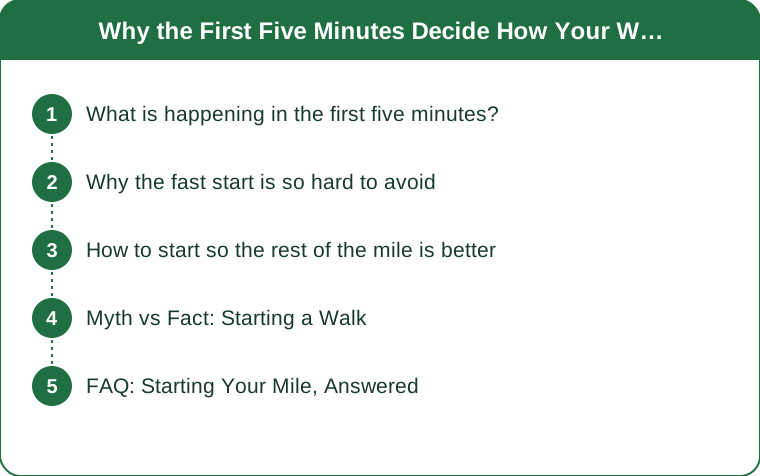
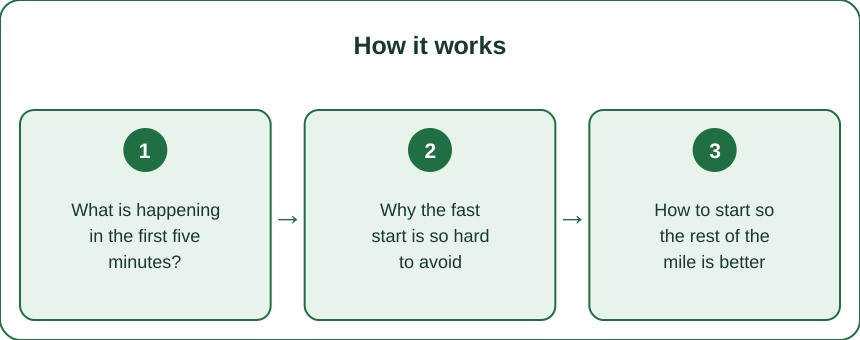
What is happening in the first five minutes?
Oxygen uptake lags demand. Your muscles need oxygen the moment you start moving; the cardiovascular system takes a few minutes to deliver it at the required rate. That gap is covered by anaerobic sources, which are limited and produce a cost.
Blood flow has to redistribute. At rest, a substantial share goes to the digestive system and organs. Moving it to working muscle is a process rather than a switch, and it takes minutes.
Muscle temperature rises slowly. Warm muscle is more compliant and more efficient. Cold muscle at the same pace costs more energy and feels heavier, which is why the same speed is harder at minute two than at minute twelve.
Heart rate overshoots then settles. A fast start typically produces a higher heart rate at minute five than the same pace produces at minute fifteen - the same work at a higher cost.
And joints need a few minutes of movement to distribute synovial fluid, which is why the first minutes feel stiff in a way that is entirely normal and entirely temporary.
Why the fast start is so hard to avoid
Legs feel fresh, so the pace feels easy. Perceived effort in the first minute is genuinely low, because fatigue has not accumulated. The pace that feels easy then is not the pace that will feel easy at minute fifteen.
A short walk feels like it needs no warm-up. For a one-mile walk the warm-up is a meaningful proportion of the total, which makes people skip it - and a mile is short enough that a bad first third ruins the whole thing.
Time pressure is usually real. A walk squeezed into a schedule starts at whatever pace gets it finished, which is precisely how the fast start becomes the default.
Cool mornings encourage it. Late summer mornings are pleasant enough that a brisk start feels natural, and the temperature that makes it feel easy does not change the physiology underneath.
And music sets cadence without asking. A high-tempo track in minute one produces a high-tempo start, which is worth knowing if your playlist begins where your energy does.

How to start so the rest of the mile is better
Spend the first five minutes at a pace you would describe as almost too slow. Not comfortable - deliberately slow. This is the whole intervention and it is the part people resist.
Use breathing rather than speed as the gauge. If you cannot speak a full sentence comfortably in the first five minutes, you are going too fast for what the walk is meant to do.
Add the effort in one step at minute five, rather than drifting up. A deliberate change is easier to control than a gradual one, and it lets you actually feel the difference the warm-up made.
Do thirty seconds of movement before you leave. Ankle circles, a few slow squats, arm swings. It shortens the adjustment period noticeably, and it costs half a minute.
Keep the first five minutes on flat ground where possible. A hill in the first three minutes forces a high effort while the system is still catching up, which is the single worst place to put one.
And accept a slower first split. If you track it, the first quarter mile being your slowest is the sign it is working, not the sign you are declining.
Myth vs Fact: Starting a Walk
Myth: walking does not need a warm-up. Fact: the aerobic transition is the same regardless of activity. The lower intensity means it matters less, not that it does not exist.
Myth: stretching first is the warm-up. Fact: static stretching is not a warm-up; movement is. Gentle movement raises muscle temperature, and stretching a cold muscle does not.
Myth: starting fast then slowing is the same total work. Fact: it is not. A fast start recruits anaerobic pathways and produces a cost that has to be repaid during the walk, which is why the middle feels worse.
Myth: for a mile it makes no real difference. Fact: for a mile it makes the most difference, because five minutes is a third of the walk. A five-mile walk absorbs a bad start; a mile does not.
Myth: if you feel good at the start, use it. Fact: feeling good at the start is what everyone feels at the start. It is not information about the rest of the walk.
FAQ: Starting Your Mile, Answered
How slow is slow enough for the first five minutes?
Slow enough that a full sentence is easy and you feel slightly impatient. If you do not feel a little impatient, it is probably not slow enough.
Does this apply to running as well?
More so, because the intensity is higher and the anaerobic cost of a fast start is larger. Runners call the fix an easy first mile, and it is the same principle.
What if I only have fifteen minutes total?
Then five slow and ten brisk beats fifteen moderate for both how it feels and what it does. Truncating the warm-up is the least useful place to save time.
Should I warm up before an evening walk too?
Less is needed - you have been moving all day and body temperature is higher in the evening. Two to three minutes usually suffices rather than five.
Does this change with the weather?
Cooler mornings lengthen the adjustment, so as autumn arrives the slow start matters more, not less. Add a minute or two once mornings drop below about 55F.
TL;DR:
- Oxygen uptake, blood redistribution and muscle temperature all take three to five minutes; going fast before that borrows from anaerobic reserves.
- The heaviness at minute eight is usually repayment for minute two.
- Spend the first five minutes deliberately slower than comfortable, then add effort in one deliberate step.
- Thirty seconds of ankle circles and arm swings before leaving shortens the adjustment noticeably.
- Keep hills out of the first three minutes, and expect your first quarter mile to be your slowest.
On a one-mile walk the warm-up is a third of the distance, which is exactly why skipping it costs the most here.
See It in Motion
Seen here: High Waist Yoga Leggings with Inner Pocket — shop it on bubblelime.com
Keep Reading
This article is for general informational and styling purposes only. Fit, sizing, and product availability may vary.