Why the First Two Minutes Decide How Your Whole Mile Feels
Quick Answer: The opening two minutes of a walk set your cadence, your breathing pattern and your gait mechanics for the rest of it, and all three are hard to change once established. Starting fast means starting before your circulation, joints and stride have adjusted, which produces a mile that feels harder at every point despite being the same distance. A deliberately slow first two minutes reliably produces a faster, easier mile — an effect large enough to notice on the very first attempt.
You did not have a worse day. You had a worse start.
And the start is the part of the walk you have the most control over and think about the least.

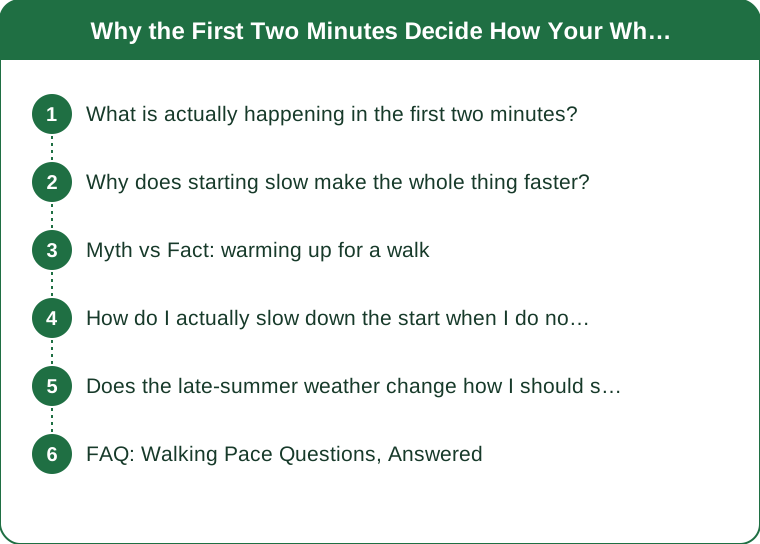
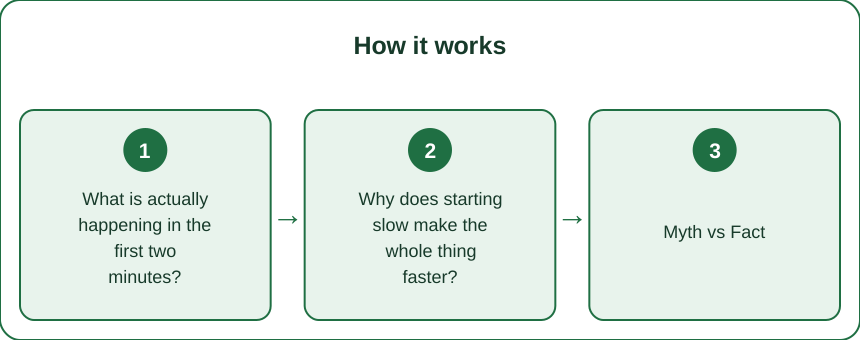
What is actually happening in the first two minutes?
Several systems catching up with each other at different speeds.
Blood flow redistributes. At rest, a small share of your circulation goes to working muscle. During exercise that share increases dramatically, but the redistribution is not instant — it takes roughly two to three minutes to substantially complete. Start hard and you are asking legs to work before they have the supply.
Synovial fluid has not moved yet. Joint cartilage is lubricated by fluid that circulates in response to movement and load. The first few minutes of walking are literally what makes the knees and hips move smoothly — which is why the first hundred steps can feel stiff and the next thousand do not.
Your gait is still assembling. Stride length, arm swing and foot strike settle into a pattern over the first few minutes. Whatever pattern you establish while stiff tends to persist, which means a rushed, short, tense start produces a rushed, short, tense mile.
And breathing lags behind effort. Ventilation catches up to demand over a minute or two. Going out fast means starting with an oxygen deficit you then carry.
Is this different for walking than running?
Same mechanisms, smaller magnitude. It matters less for walking, and it still matters more than most walkers assume.
Why does starting slow make the whole thing faster?
Because of what it prevents rather than what it adds.
When you start above your sustainable effort, your body does not simply slow down later — it overcorrects. You slow more than you needed to, you break rhythm, and the walk becomes a series of speed adjustments rather than a steady effort.
Steady effort is more efficient than variable effort at the same average. Every acceleration costs energy that a constant pace does not.
There is also a perception effect that is well documented in endurance research: effort experienced early anchors how hard the whole session feels. A walk that starts uncomfortable is remembered as a hard walk even if the last three quarters were easy.
What this looks like in practice:
- First two minutes: deliberately slower than feels natural. If you have a normal walking pace, go noticeably below it.
- Next two minutes: ease up to your normal pace without any conscious push.
- Remainder: let it drift up if it wants to. It usually does.
Most people who try this find their overall time is the same or faster and the walk feels substantially easier, which is the trade you actually want.
Myth vs Fact: warming up for a walk
Myth: Walking is gentle enough that it does not need a warm-up. Fact: It does not need a separate warm-up. It absolutely benefits from the first few minutes being the warm-up, which is a different thing and free.
Myth: Stretching before a walk is the way to prepare. Fact: Static stretching on cold muscle has no established benefit before low-intensity activity and may temporarily reduce power output. Movement is the better preparation.
Myth: Starting fast gets you a better workout in less time. Fact: It usually produces a slower average and a higher perceived effort. The compressed-time argument does not survive contact with the stopwatch.
Myth: If you feel stiff at the start, you should push through it quickly. Fact: Early stiffness is largely a lubrication and circulation issue that resolves with a few minutes of gentle movement. Pushing through it is the mechanism by which minor niggles become real ones.
Myth: The first two minutes are too short to matter. Fact: They are about 10 to 15 percent of a mile walk, and they set the pattern for the other 85. That is a large lever for a small input.

How do I actually slow down the start when I do not want to?
Because the honest problem is that a slow start feels like wasting time.
The strategies that work:
- Give the first two minutes a job. Not pace — form. Count your steps, check your shoulders are down, notice your foot strike. Attention on mechanics naturally slows pace without it feeling like restraint.
- Use a landmark, not a timer. Decide that you walk easy until the second corner. A physical marker is far easier to obey than a clock.
- Breathe in a fixed pattern. In for three steps, out for three. Almost nobody can start too fast while doing this.
- Start walking before you decide the route. Deciding while moving occupies the part of your brain that wants to push.
- If you walk with someone, talk from step one. Conversation enforces a sustainable pace better than any device.
What if I only have fifteen minutes?
Then the slow start matters more, not less. A rushed fifteen-minute walk produces a worse average and more stiffness than a well-started one, and the two minutes are not lost — they are the reason the other thirteen work.
Does the late-summer weather change how I should start?
It does, and in the direction most people get wrong.
Warm, humid mornings feel easy to start fast in. Muscles are already warm, joints move freely, and the usual physical brake on a hard start is not there. So people go out at a pace they cannot hold, and then the humidity — which impairs cooling by reducing sweat evaporation — makes the second half disproportionately harder.
Cool mornings are the opposite. As late August tips toward September, early-morning temperatures are dropping meaningfully and your first two minutes need to be longer, not shorter. Cold muscle and cold joints take more time, not less, to reach normal function.
A seasonal adjustment worth making now:
- On humid days, hold the easy pace for three minutes rather than two, and expect your effort to feel higher at the same speed. That is the humidity, not your fitness.
- On the first genuinely cool mornings, extend the easy start to four or five minutes. Stiffness that would resolve in two minutes in July takes longer at 12 degrees.
- Dress for minute ten, not minute one. You should feel slightly cool leaving the house. If you are comfortable at the door, you will be too warm by the halfway point.
And one thing that becomes relevant fast from here on: as light levels drop in the mornings, footing quality changes. Wet leaves and damp pavement reduce grip considerably, and a cautious start also happens to be a safer one.
This is general information, not medical advice.
FAQ: Walking Pace Questions, Answered
How slow is slow enough for the first two minutes?
A pace you could comfortably hold while telling a story. If you would have to pause for breath mid-sentence, it is still too fast.
Does this apply if I walk multiple times a day?
Yes, and to each one. Sitting for two hours undoes most of the readiness the previous walk created.
Will a slow start reduce the health benefit?
No. Total volume and average intensity across the walk drive the benefit, and both usually go up rather than down with a slow start.
What about walking uphill from the very first step?
That is the hardest case, and worth avoiding when you can. If the route starts on a climb, walk it at a genuinely easy effort and accept the slow split.
Should I use a step counter to control this?
Cadence is more useful than steps. Aim for a lower steps-per-minute in the opening two minutes and let it rise naturally afterwards.
TL;DR:
- Circulation, joint lubrication, gait and breathing all need two to three minutes to catch up with effort.
- Starting fast produces overcorrection and a variable pace, which is less efficient than steady effort at the same average.
- Early effort anchors how hard the whole walk feels, regardless of what happens later.
- Use a landmark rather than a timer, and give the first two minutes a form-related job.
- Humid days need three minutes; cool autumn mornings need four or five. Cold joints take longer, not less.
- Dress to feel slightly cool at the door.
The mile did not get harder. You just started it before your body had agreed to.
See It in Motion
Seen here: High Waist Yoga Leggings with Side Pockets — shop it on bubblelime.com
Keep Reading
This article is for general informational and styling purposes only. Fit, sizing, and product availability may vary.