Treadmill Mile vs Outdoor Mile: Does It Actually Matter?
Quick Answer: A treadmill mile at 1% incline closely matches the effort of an outdoor mile on flat ground — the bigger differences are mental (pacing discipline, boredom) and environmental (wind, terrain), not calorie burn.
You’ve committed to your one mile a day, but on rainy mornings the treadmill feels like cheating somehow. It isn’t — you’re just trading one set of variables for another.

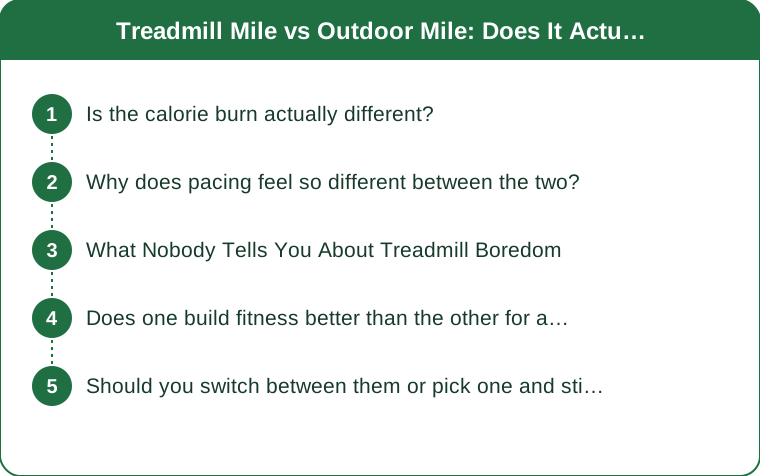
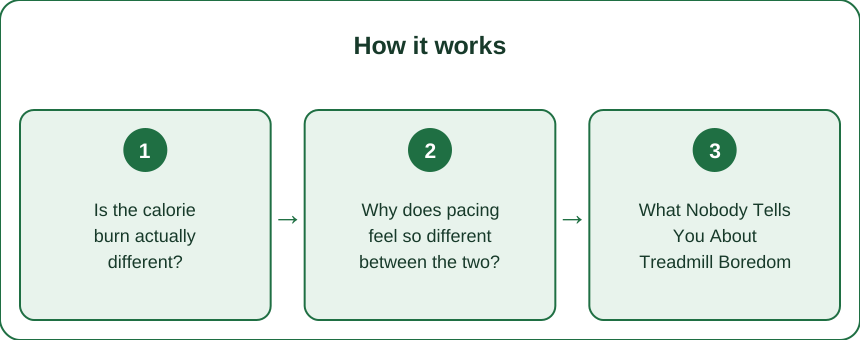
Is the calorie burn actually different?
Outdoors, you’re fighting air resistance and, depending on terrain, small elevation changes your legs have to stabilize for — a treadmill belt moves under you, removing both. Research consistently shows treadmill running burns slightly less unless you set a 1% incline, which is the commonly cited number to offset the lack of wind resistance.
At the distance of one mile, though, the actual calorie difference is small enough that it shouldn’t be the deciding factor either way.
Why does pacing feel so different between the two?
A treadmill sets your pace for you — you either keep up or you don’t, which removes the self-negotiation that happens outdoors (‘I’ll speed up at the next mailbox’). That external pacing can be a genuine advantage if you tend to start too fast and fade, since the belt won’t let you.
Outdoors, pacing is entirely on you, which builds a pacing instinct the treadmill doesn’t train — useful if you ever plan to race somewhere without a display counting your speed.

What Nobody Tells You About Treadmill Boredom
The lack of changing scenery isn’t just an annoyance — it measurably increases perceived exertion for the same actual effort in several studies, meaning a treadmill mile can feel harder even at matched pace and incline. This isn’t a discipline failure, it’s a real perceptual effect.
Music, a show, or simply facing a window helps close that gap more than people expect.
Does one build fitness better than the other for a beginner?
For someone starting a one-mile-a-day habit, the treadmill’s controlled, joint-friendly surface (usually softer than pavement) and built-in pacing make it a genuinely good entry point, especially in bad weather or unsafe outdoor conditions.
Outdoor running adds balance and stabilizer demands from uneven ground, which has its own value once your base fitness is established — neither is strictly ‘better,’ they train slightly different things.
Should you switch between them or pick one and stick with it?
Alternating is genuinely fine and arguably better long-term — it varies the stress on your joints and keeps the habit from feeling monotonous, which matters more for a daily habit than for a training block. The goal of a one-mile-a-day habit is consistency, and consistency survives boredom better when the routine has some variety.
If weather or safety makes the treadmill your only realistic option most days, that’s a completely valid version of the habit — showing up matters more than the surface.
TL;DR:
- A 1% incline treadmill mile roughly matches an outdoor flat mile in effort
- Treadmill pacing is externally set; outdoor pacing trains your own pacing instinct
- Treadmill miles can feel harder due to lack of scenery, even at equal effort
- Alternating surfaces is fine and can help long-term consistency
Neither surface makes your daily mile more or less ‘real’ — the habit is the part that counts, and both surfaces build it.
See It in Motion
Seen here: High Waist Yoga Leggings with Side Pockets — shop it on bubblelime.com
Keep Reading
This article is for general informational and styling purposes only. Fit, sizing, and product availability may vary.