Why a Mile Feels Easier With a Podcast Than With Music - and When to Switch
Quick Answer: At easy effort, a podcast usually makes a mile feel shorter because narrative pulls attention away from your body. At hard effort, music wins because rhythm can pull your cadence along and attention narrows anyway. The crossover sits roughly where you can no longer follow a complex sentence - typically the point where talking in full sentences gets awkward. Practical rule: podcast for the daily easy mile, music for anything that feels like work.
This is not a preference thing. It is about where your attention can actually go at a given intensity.
And it explains why the playlist that carries you through a hard run does nothing for an evening walk.
Why does narrative make an easy mile feel shorter?
Because at low intensity your attention has somewhere else to be.
Researchers describe two attentional modes during exercise: associative - focused inward on breathing, legs, effort - and dissociative, focused outward on anything else. Dissociation reliably lowers perceived exertion at easy and moderate intensities.
A podcast or audiobook is unusually good at this because narrative demands continuous attention. You cannot half-follow a story the way you can half-hear a song. Your working memory is genuinely occupied, so there is very little left to spend on monitoring how your legs feel.
There is also a time-perception effect. Absorbed attention compresses subjective duration - the mile does not just feel easier, it feels shorter, which are two separate things.
Where it breaks down: as intensity rises, your body starts demanding attention that you cannot refuse. Above a certain effort, associative focus becomes involuntary. You will notice this as suddenly realizing you missed the last two minutes of the episode.
Why does music take over when the effort goes up?
Because music works through a different mechanism that does not require spare attention.
Rhythm entrainment. People spontaneously synchronize their steps to a beat, and a tempo slightly above your natural cadence tends to pull the cadence up without a corresponding rise in perceived effort. Most walking cadences land somewhere around 110-130 steps per minute; easy running is often near 160-170. Matching the track’s tempo to that range is the whole trick.
Arousal, not distraction. Music with a strong beat raises physiological and psychological arousal directly. That effect survives at intensities where distraction stops working, which is precisely why hard efforts feel better with music and worse with talk.
Lyrics stop mattering when you are working hard. At high effort, most people process music as rhythm and texture rather than content - so the song you love and the song with the right BPM perform about equally.
And the practical tell: if you are re-winding the podcast, you are working too hard for a podcast.
So what should I actually put on for a one-mile walk?
It depends on which job the mile is doing that day.
The habit mile - the one you do because you always do it. Podcast or audiobook. Attach the audio to the walk and the walk borrows the pull of the story. People who only let themselves listen to one particular show while walking report the strongest version of this - the show becomes the reason to go.
The mood mile - the after-work reset. Music, and specifically something moderate rather than intense. Loud, high-tempo music raises arousal, which is the opposite of what a decompression walk is for.
The thinking mile - the one where you are working a problem out. Nothing. Silence is genuinely a category here, and unoccupied attention during light movement is where a lot of people do their best untangling.
The pace mile - the one where you are pushing. Music at a tempo just above your current cadence.
The evening mile - after dinner. Podcast, and keep the volume low enough to hear traffic. This is also the mile with the best metabolic argument behind it, so it is worth protecting as a habit.

Myth vs Fact: Audio and Walking
Myth: Music makes every workout easier. Fact: at easy intensity, narrative audio usually beats music for perceived effort. Music’s advantage shows up as intensity climbs.
Myth: You should never walk with headphones for safety reasons. Fact: the risk is real but the fix is volume and awareness, not abstinence. Bone-conduction or open-ear designs leave ambient hearing intact, and one earbud out works nearly as well.
Myth: Faster music always makes you move faster. Fact: the entrainment effect is strongest when the tempo is close to your natural cadence. A tempo far above it gets ignored - you simply stop synchronizing.
Myth: Listening to something means you are not really exercising. Fact: perceived effort drops but the physiological work does not change. The mile counts exactly the same. In fact, if distraction is what gets you out the door consistently, it is doing the most important job there is.
Myth: Audiobooks are the same as podcasts here. Fact: close, but audiobooks demand slightly more continuous attention, which makes them better for very easy walking and worse the moment the terrain gets demanding.
Does the season change what works?
More than you would expect, and late summer into fall is the biggest shift of the year.
Evening light disappears fast in September. The after-dinner mile that felt safe in July is happening at dusk by mid-September. This is the point to switch to one earbud, lower volume, or open-ear headphones - not because the audio changed, but because the environment did.
Cooler air makes hard efforts feel easier, which shifts your personal crossover point. A pace that demanded music in August may be comfortable enough for a podcast in October. Recheck rather than assuming.
Routine is fragile at the seasonal change. The mile that survived summer often dies in the first cold, dark week of fall. Front-loading the audio reward helps - starting a new season of something you actually want to hear is a legitimate consistency strategy.
And the volume creep is real. People raise the volume as wind and traffic noise increase in the fall. Set a ceiling on your phone and forget about it - the habit is worth more than the extra few decibels.
FAQ: Walking Audio Questions, Answered
Does listening to something make the walk less beneficial?
No. Perceived effort and actual physiological effort are different things, and the cardiovascular and metabolic benefits do not care what is in your ears. The only real trade is losing the mental-processing benefit of silence.
What tempo should I look for if I want to walk faster?
Start around 120-130 BPM for walking and adjust from feel. Match slightly above your natural cadence, not dramatically above - too fast and the synchronization simply does not happen.
Is one earbud actually safer than two?
Yes, meaningfully. Directional hearing requires both ears, so one earbud lets you locate a car or a bike that two earbuds turn into vague background sound. Use the ear facing away from traffic.
TL;DR:
- Podcasts win at easy effort because narrative occupies the attention you would otherwise spend monitoring your body.
- Music wins at hard effort through rhythm and arousal, which work without needing spare attention.
- The crossover is roughly where full sentences get awkward - if you are re-winding, switch to music.
- Silence is a real option for the mile where you are trying to think something through.
- Recheck your setup as evenings darken - one earbud or open-ear designs, and a volume ceiling.
Try the same route tomorrow with the opposite of what you usually play. Most people are surprised by which one makes the mile disappear.
See It in Motion
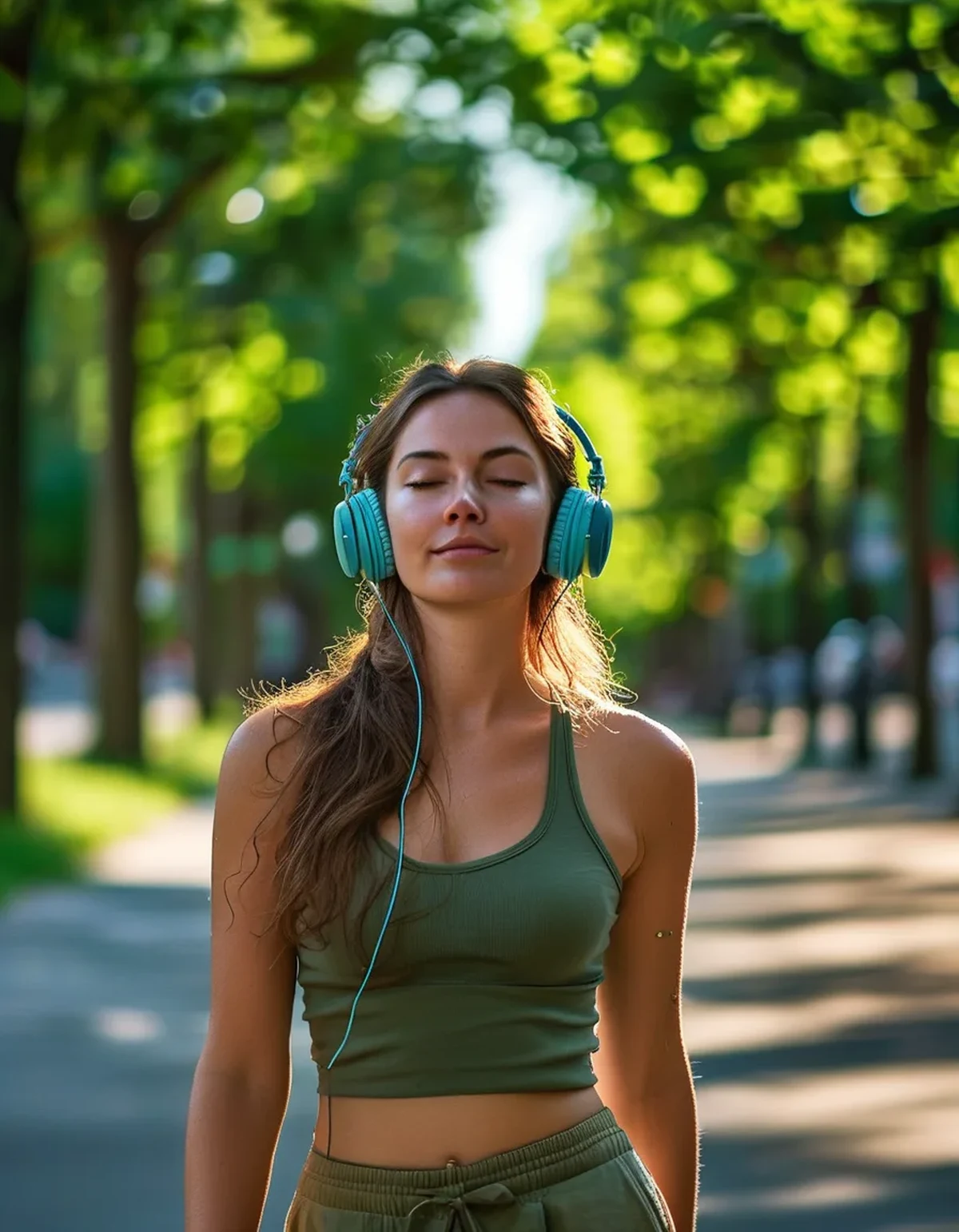
Seen here: High Waist Jogger Sweatpants with Pockets — shop it on bubblelime.com
Keep Reading
This article is for general informational and styling purposes only. Fit, sizing, and product availability may vary.