Why a One-Mile Daily Habit Sticks When Bigger Fitness Goals Usually Don't
Quick Answer: A one-mile daily habit sticks better than bigger fitness goals mainly because its low time and effort cost keeps the daily decision to start almost frictionless, avoiding the all-or-nothing burnout pattern that derails more demanding routines — and because it’s easy to complete even on a bad day, it rarely gets skipped entirely, which is the single biggest predictor of whether a habit survives long-term.
The habits that survive aren’t usually the most ambitious ones — they’re the ones small enough to survive a bad day without being abandoned entirely.

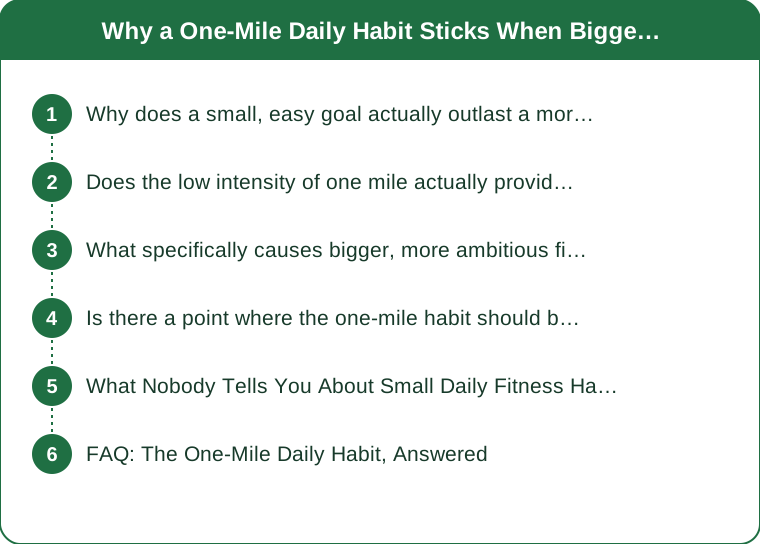
Why does a small, easy goal actually outlast a more ambitious one, from a habit-formation standpoint?
Habit formation research consistently shows that consistency, not intensity, is the strongest predictor of whether a behavior becomes automatic. A one-mile goal is small enough to complete even on a low-energy, busy, or unmotivated day, which keeps the streak unbroken — while a demanding hour-long workout goal gets skipped entirely on exactly those harder days, and each skip makes the next skip more psychologically likely.
Does the low intensity of one mile actually provide meaningful fitness benefit, or is it mostly a mental trick?
Both — a consistent one-mile daily habit provides genuine, real cardiovascular and mood benefit on its own, and it also frequently serves as a reliable entry point that naturally extends into more on higher-energy days, without that extension being required for the habit to count as a success. The low bar is deliberately part of the design, not a compromise.
What specifically causes bigger, more ambitious fitness goals to fail so much more often?
All-or-nothing goals create a psychological trap where missing one demanding session, due to time, energy, or motivation, easily cascades into missing several more, since the goal already feels effortful and a single miss removes the accountability of an unbroken streak. A goal small enough to always be achievable removes this all-or-nothing failure trigger almost entirely.

Is there a point where the one-mile habit should be increased, or does staying small work indefinitely?
Many people naturally extend the distance once the habit itself has become automatic, often after a few consistent months, since the identity of “someone who walks or runs daily” is the harder part to build — extending an already-automatic habit is comparatively easy. Increasing the distance too early, before the daily habit itself is solid, risks reintroducing the same all-or-nothing failure pattern.
What Nobody Tells You About Small Daily Fitness Habits
The specific time of day a one-mile habit is attached to matters more than most people expect — anchoring it to an existing daily routine (right after coffee, right before showering) makes it dramatically more likely to survive long-term than a habit that has to be actively remembered and scheduled fresh each day, since it borrows the existing routine’s own automaticity.
FAQ: The One-Mile Daily Habit, Answered
Does walking count the same as running for this habit-building effect?
Yes — the habit-formation benefit comes primarily from consistency and low barrier to completion, not from the specific intensity, so walking a mile daily builds the same durable habit pattern as running one.
Is it a setback if a day gets missed entirely?
A single missed day rarely derails a well-established habit, though missing multiple days in a row is the pattern most worth actively guarding against, since that’s when the habit is most at risk of fully lapsing.
Should the one-mile goal ever be paired with a bigger weekly goal?
Some people find pairing the daily minimum with a flexible weekly bonus goal (an extra longer walk once a week) works well, as long as the daily minimum itself stays untouched as the true non-negotiable habit.
TL;DR:
- Small, consistently achievable goals outlast ambitious ones because they avoid the all-or-nothing failure trap
- A one-mile habit provides genuine fitness benefit on its own, not just a psychological placeholder
- Bigger goals fail more often because a single missed session cascades into more missed sessions
- Anchoring the habit to an existing daily routine makes it far more likely to survive long-term
A one-mile daily habit sticking where bigger goals fail isn’t a coincidence — it’s a predictable result of removing the all-or-nothing trigger that derails more demanding routines.
See It in Motion
Seen here: High Waist Embossed Yoga Leggings with Side Pockets — shop it on bubblelime.com
Keep Reading
This article is for general informational and styling purposes only. Fit, sizing, and product availability may vary.