Why Running One Mile Every Day Beats Skipping Days and Doing Three Miles Instead
Quick Answer: Even though the weekly mileage total can look similar, daily one-mile runs build a more consistent training stimulus and a stronger habit loop than sporadic longer runs, since fitness adaptations and habit formation both respond more reliably to frequent, small, repeated exposure than to occasional larger efforts with gaps between them.
One mile daily and three miles every few days can add up to similar weekly totals, but the body and the habit respond very differently to each pattern.

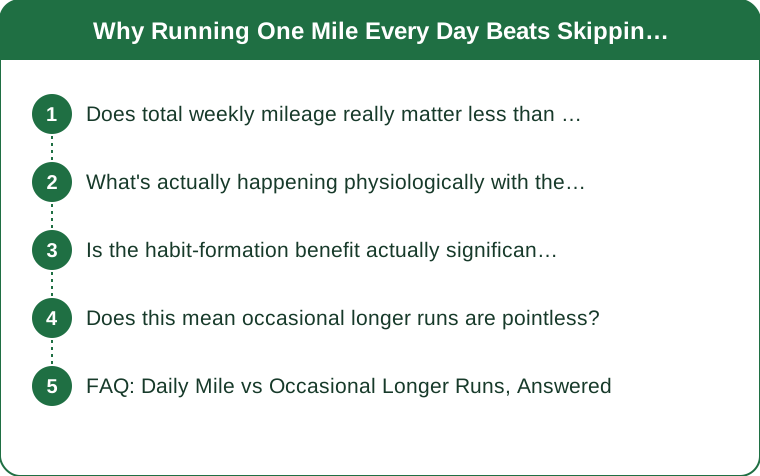
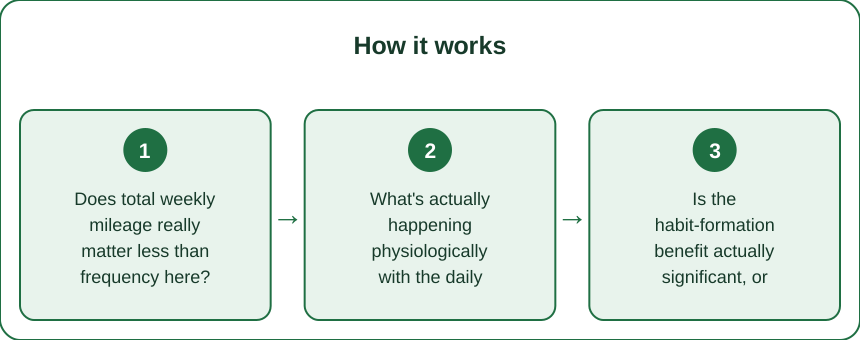
Does total weekly mileage really matter less than frequency here?
For habit formation and consistent low-level adaptation, yes — frequency provides a more stable, repeated training stimulus than the same total distance delivered in fewer, larger doses with recovery gaps in between.
What’s actually happening physiologically with the daily approach?
Frequent, moderate stimulus supports more consistent cardiovascular and muscular adaptation over time, since the body isn’t cycling between exertion and multi-day rest as dramatically as it does with sporadic longer efforts.

Is the habit-formation benefit actually significant, or just a nice bonus?
It’s significant — daily habits are considerably easier to maintain long-term than habits with built-in skip days, since consistency itself, not just distance covered, is one of the strongest predictors of whether an exercise routine actually sticks.
Does this mean occasional longer runs are pointless?
No — longer runs still build different adaptations (endurance capacity, mental toughness for distance) that a one-mile daily habit doesn’t replicate. The daily mile is about consistency and baseline habit, not a full replacement for longer training goals.
FAQ: Daily Mile vs Occasional Longer Runs, Answered
Can I combine both approaches in the same week?
Yes — many runners use a daily mile as a baseline habit while adding a longer run once or twice weekly for additional endurance goals.
Is one mile actually enough to provide real cardiovascular benefit?
For general health maintenance, yes — one consistent mile daily provides meaningful benefit, especially compared to sporadic activity with long gaps.
Does the daily mile need to be at a specific pace to count?
No — consistency of the habit matters more than pace for the general health and habit-formation benefits being discussed here.
TL;DR:
- Similar weekly totals produce different outcomes depending on frequency versus occasional volume
- Frequent moderate stimulus supports more consistent physiological adaptation over time
- Daily habits are considerably easier to sustain long-term than habits with built-in skip days
- Longer occasional runs still matter for endurance goals a daily mile alone doesn’t cover
See It in Motion
Seen here: High Waist Yoga Leggings with Side Pockets — shop it on bubblelime.com
Keep Reading
This article is for general informational and styling purposes only. Fit, sizing, and product availability may vary.