Why the First Quarter Mile of Any Walk or Run Always Feels the Hardest
Quick Answer: The first quarter mile feels hardest because the body hasn’t yet shifted from resting to exercise metabolism — blood flow redistribution, joint lubrication, and breathing rhythm all take a few minutes to catch up to the new demand, creating a temporary mismatch that resolves once the body’s systems adjust.
That rough opening stretch where everything feels stiffer and harder than it will ten minutes later isn’t a sign of a bad walk ahead — it’s a predictable physiological lag, and it almost always passes.

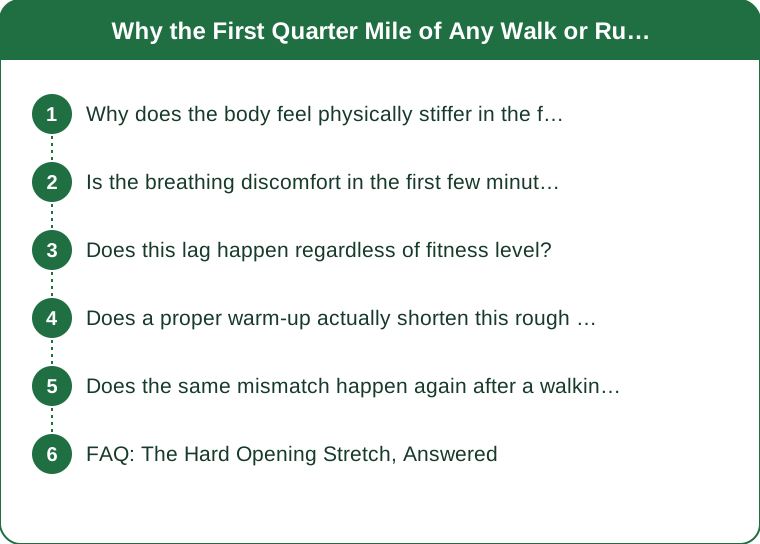
Why does the body feel physically stiffer in the first few minutes?
Joint synovial fluid (which lubricates joints) and muscle tissue both take a short warm-up period to reach optimal viscosity and elasticity for movement — cold or resting-state tissue is genuinely less pliable than tissue that’s been moving for several minutes, which is a real mechanical factor, not just a perception issue.
Is the breathing discomfort in the first few minutes a real physiological lag too?
Yes — the cardiovascular and respiratory systems take roughly 2-3 minutes to fully shift from resting-state blood flow distribution to exercise-state distribution, redirecting blood toward working muscles and adjusting breathing rate to match new oxygen demand. This transition lag is sometimes called reaching ‘second wind,’ and it’s a well-documented exercise physiology phenomenon, not a fitness limitation.
Does this lag happen regardless of fitness level?
Largely yes — even highly trained athletes experience this early-effort mismatch, though the duration and intensity of the uncomfortable window often shortens somewhat with training. It’s a normal transition phase built into how the body shifts states, not primarily a marker of fitness level.

Does a proper warm-up actually shorten this rough opening stretch?
Yes, measurably — a few minutes of gentle movement (a slow walk before picking up pace, or light dynamic stretching) before the main effort begins gives the cardiovascular and joint systems a head start on the transition, which is why athletes across nearly every sport build in a warm-up rather than starting cold at full intended effort.
Does the same mismatch happen again after a walking break mid-route?
A brief pause (under a few minutes) typically doesn’t reset the transition fully, so resuming after a short break usually feels easier than the original start. A longer break (10+ minutes) is more likely to require re-adjusting through a milder version of the same initial discomfort, since the body has had more time to shift back toward a resting state.
FAQ: The Hard Opening Stretch, Answered
Should you push through the discomfort or slow down during the first quarter mile?
Slowing down slightly during this window is commonly recommended — starting at a more moderate pace allows the physiological transition to happen without adding extra strain on top of it.
Does this explain why a walk sometimes never feels good the whole way through?
Not fully — if discomfort persists well past the first 10 minutes rather than easing, that’s more likely due to pace, hydration, or fatigue from other factors than this specific opening-stretch transition.
Is the ‘hardest part is starting’ feeling partly psychological too?
Some of it is motivational, but the underlying physiological transition (blood flow, joint lubrication, breathing adjustment) is a real, measurable factor independent of mindset.
TL;DR:
- The first quarter mile feels hardest due to a real physiological lag, not lack of fitness
- Joints and muscles take a few minutes to reach optimal movement-ready condition
- Cardiovascular and breathing systems take roughly 2-3 minutes to shift from resting to exercise state
- A gentle warm-up before main effort shortens this uncomfortable transition window
The rough start isn’t a preview of how the rest of the walk will feel — it’s your body catching up, and it almost always does within the first several minutes.
See It in Motion
Seen here: Yoga Jogger Sweatpants with Pockets — shop it on bubblelime.com
Keep Reading
This article is for general informational and styling purposes only. Fit, sizing, and product availability may vary.