Why the Same Mile Feels Different at 7am and 7pm
Quick Answer: Your 7am mile feels stiff for the first quarter and then smooths out, because core temperature and joint lubrication are at their daily low when you wake. Your 7pm mile starts easier but often feels heavier overall, because you are carrying a full day of accumulated fatigue, decisions, and — in August — heat radiating back off the pavement. Neither version is the true measure of your fitness. They are two different tests, and expecting the same result from both is where most of the frustration comes from.
If your evening mile has been making you doubt your progress, the mile is fine. The clock is doing exactly what clocks do to bodies.

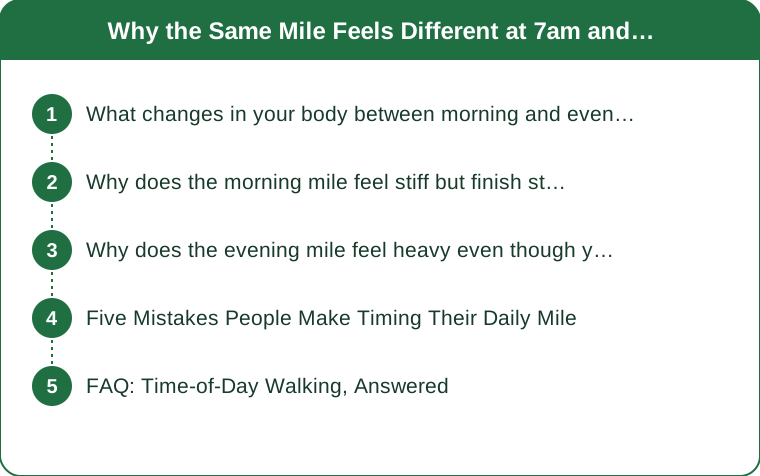
What changes in your body between morning and evening?
More than most people realize — the body at 7am and the body at 7pm differ on almost every measure that affects walking.
Core temperature swings by nearly two degrees. It bottoms out shortly before waking and peaks in the late afternoon. Warmer muscles are measurably more elastic and contract more efficiently, which is why formal athletic performance tends to peak between 4 and 7pm.
Joints start the day dry. Synovial fluid — the lubricant in your knees, hips, and ankles — thins and circulates with movement. After a night of stillness, the first few hundred steps are literally the lubrication process happening.
Fuel state differs. At 7am you are 10 or more hours from your last meal; at 7pm you are digesting the day. Neither is bad for a mile, but they feel different — the morning body runs lighter and slightly flatter, the evening body runs fueled and slightly heavier.
And the environment flips. In late August, a 7am sidewalk might be 68 degrees with cool air; the same sidewalk at 7pm has been banking sun all day and radiates it back at you. Air temperature alone understates the evening difference — pavement heat is a real, felt load.
Same mile, two operating conditions. The interesting part is that the discomforts do not overlap at all.
Why does the morning mile feel stiff but finish strong?
Because everything wrong with the morning mile resolves inside it.
The first 400 meters are the worst of the day: cool muscles, unlubricated joints, blood pressure and circulation still ramping from sleep mode. Perceived effort in the first five minutes of a morning walk is genuinely elevated — you are not imagining that the start feels creaky.
Then the systems arrive. Joint fluid distributes, muscle temperature climbs, and the cortisol awakening response — a natural morning surge that peaks about 30 to 45 minutes after waking — delivers alertness at exactly the moment your body warms. The second half of a morning mile frequently feels better than any other walking of the day.
There is also a psychological tailwind: nothing has gone wrong yet. No accumulated decisions, no lunch sitting heavy, no inbox residue. The morning mile competes only with sleep inertia, and sleep inertia loses by minute six.
The practical adjustment is simply to stop judging the walk by its first quarter. Give it a slower opening 200 meters on purpose — a deliberately easy start is not lost time, it is the warmup the hour requires. Walkers who sprint out the door at their target pace experience the stiffness as a struggle; walkers who ease in experience it as a ramp.

Why does the evening mile feel heavy even though your body is primed?
This is the great irony of the 7pm mile: physiologically it should be your best, and perceptually it is often your worst.
By evening your muscle temperature is ideal and your joints have been moving all day. The heaviness is coming from everything else. Mental fatigue from a day of decisions raises perceived effort without touching actual capacity — the same pace reads as harder because your brain is pricing in the whole day. Hours of sitting leave hip flexors shortened and posture compressed. And an August evening adds radiant pavement heat that the forecast never mentions.
The result is a strange split: your watch says the evening mile is the same speed or faster, while your body votes that it was harder. Both are right. Output is fine; the experience is taxed.
Two fixes close the gap. First, put five minutes of buffer between the day and the walk — change clothes, drink water, step outside without your phone. The costume change into something you only walk in, even just swapping into high-waisted leggings and a clean shirt, functions as a mental gate more than a wardrobe decision. Second, judge evening walks by effort, not by pace. A relaxed evening mile that feels like a six out of ten is doing the same cardiovascular work as the brisk morning version — the day has just raised the price of everything.
And if the evening mile is consistently miserable rather than just heavy, that is the signal to move it, not to abandon it.
Five Mistakes People Make Timing Their Daily Mile
Judging fitness by the evening walk. Evening perceived effort tracks your day as much as your body. If you want a clean fitness read, compare morning miles to morning miles.
Skipping the warmup because it is just walking. The first quarter of a cold-start mile is the warmup. Starting at target pace from the doorstep is why morning walks feel harder than they should.
Racing yesterday’s time across different hours. A 7am time and a 7pm time are not comparable data points. Track them as two separate streaks or the numbers will lie to you in both directions.
Dressing for the thermometer instead of the hour. The 7pm forecast temperature ignores pavement heat; the 7am number ignores that you warm two degrees within minutes. Evening wants lighter clothing than the reading suggests, morning wants one removable layer over whatever you would wear at noon — a light zip over yoga pants beats guessing.
Quitting the habit because one slot feels bad. The most common walking-habit failure is concluding you have lost fitness when really the walk drifted into a slot where life taxes it. Move the mile to a different hour for one week before you decide anything about yourself.
FAQ: Time-of-Day Walking, Answered
Which time is actually best?
For performance, late afternoon. For consistency, whichever slot has the fewest competing demands — for most people that is morning, because nothing schedules itself at 7am against you. Consistency beats optimization by a wide margin.
Should I eat before a 7am mile?
Optional for a mile. Water matters more — you wake mildly dehydrated. If you feel flat, a small carbohydrate — half a banana — fifteen minutes before is plenty.
Will a 7pm mile hurt my sleep?
For a walk, almost never — gentle evening movement is associated with better sleep for most people. Finish vigorous versions at least an hour before bed, and let the last ten minutes be genuinely easy.
How much slower should I expect one slot to be?
A 30 to 60 second spread across the day on a mile is completely normal. If your evening pace matches your morning pace, your evening effort was actually higher — count that as the stronger walk, not the same one.
TL;DR:
- Morning miles start stiff because core temperature and joint lubrication bottom out overnight — ease into the first 200 meters.
- Evening miles feel heavy from accumulated mental fatigue and August pavement heat, even while actual output stays fine.
- Compare morning times to morning times only; a 30 to 60 second daily spread is normal.
- A five-minute buffer and a change of clothes fixes most of what is wrong with the 7pm mile.
This week, walk your mile at both ends of the day once and write down how each felt at the quarter mark. The difference you record is your body’s daily rhythm — schedule with it, not against it.
See It in Motion
Seen here: Super High Waist Embossed Yoga Leggings with Inner Pocket — shop it on bubblelime.com
Keep Reading
This article is for general informational and styling purposes only. Fit, sizing, and product availability may vary.