Why the Same Mile Feels Easier on Grass Than on Pavement
Quick Answer: Grass reduces peak impact forces, but the larger effects are that an uneven surface forces constant small variations in your foot placement - which distributes load across more tissue instead of hammering the same spot each step - and that softer ground slows you slightly, lowering effort at the same perceived pace. The trade-off is more stabiliser work and a higher ankle risk on rough ground. The best use is alternating surfaces rather than choosing one.
Which is a useful thing to know if the same daily mile has started to bother your shins or knees.

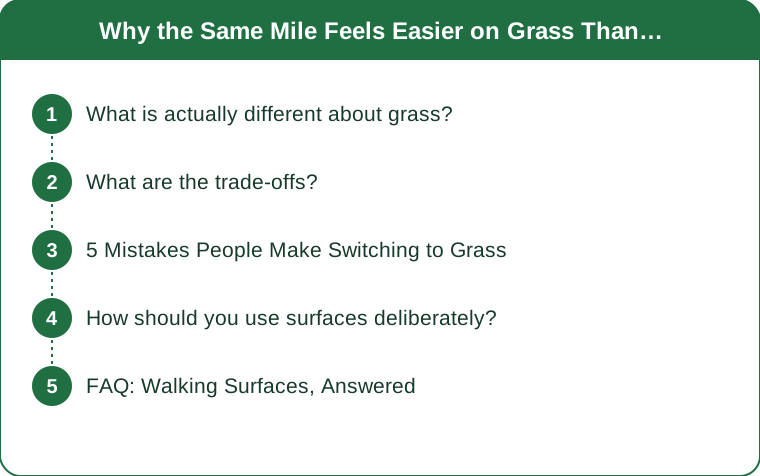
What is actually different about grass?
Three mechanisms, in order of how much they matter.
1. Variation, not just cushioning. This is the underrated one. On pavement, every step lands on an identical surface at an identical angle, so the same tissues absorb the same load in the same place several thousand times. Grass is subtly uneven, so each step differs slightly - ankle angle, foot placement, load distribution. Load spread across more structures is load that accumulates more slowly in any one of them.
2. Impact attenuation. Grass and soil compress under your foot, extending the time over which the impact force is delivered. A longer deceleration means a lower peak force. The effect is real though smaller than people assume for walking - it matters much more for running.
3. Energy return, which works against you slightly. Soft ground absorbs some of the push-off energy that pavement returns. You do marginally more work per step on grass, which is why a mile on grass at the same effort takes slightly longer. Most people read that as easier because the pace dropped without the effort rising.
And a fourth, less physical: grass usually means a park, and a park usually means daylight, greenery, and fewer road crossings. Some of the difference in how the mile feels is genuinely environmental, and that counts.
What are the trade-offs?
Grass is not free, and the costs land in different places.
Ankle risk goes up on uneven ground. The same variation that spreads load also creates opportunities to land badly. Rough, tussocky, or hidden-hole terrain is a genuine risk, particularly in low light and particularly if you have a history of ankle sprains.
Stabiliser muscles work harder. This is a benefit and a cost. Your first few grass miles will produce ankle and foot soreness that pavement did not - that is adaptation, not injury, but it means building up rather than switching entirely overnight.
Wet grass changes everything. Slippery grass on a slope forces a shortened, tentative stride that loads differently and tires you faster. From September onward, dew that does not clear until midday makes morning grass a different surface from the one you walked in July.
Camber is the hidden problem. Many grass areas slope for drainage. Walking a consistent camber loads one leg differently from the other, which is the same problem as always walking on the same side of a cambered road. Reverse your route direction regularly.
And shoes matter more. Road shoes on wet grass have poor grip. This does not require trail shoes for a park mile, but it does mean paying attention on slopes.
This is general information, not medical advice.

5 Mistakes People Make Switching to Grass
1. Switching completely, immediately. Going from all pavement to all grass in a week produces foot and ankle soreness that gets misread as an injury. Alternate - two grass walks and three pavement walks a week to start.
2. Walking the same loop in the same direction. Camber compounds. Reverse direction every other walk and the asymmetric loading resolves.
3. Assuming softer always means better. Very soft, boggy ground is hard work and unstable, and sand is a substantially harder surface to walk on than either grass or pavement despite being the softest. Soft is not a linear scale of benefit.
4. Walking grass in low light without knowing the ground. Holes, roots, and hidden dips are the actual injury mechanism, and they are invisible at dusk. Learn a route in daylight before walking it in the dark, which matters increasingly as evenings shorten through September.
5. Expecting the same pace. Your mile will be slower on grass and that is the mechanism working, not a fitness decline. Judging a grass mile by a pavement pace is how people talk themselves out of the better surface.
The third one catches most people out - the assumption that softer is a straight line to gentler does not survive contact with a beach.
How should you use surfaces deliberately?
A simple weekly structure that gets the benefit without the risk.
Alternate rather than choose. The tissue-loading argument for grass is about variation, so the ideal is variation between surfaces too. Three pavement walks and two grass walks gives you both the load-spreading and the predictable, low-risk baseline.
Put grass on the days after a harder session if you train. Softer surfaces suit recovery walking well, and the reduced peak forces genuinely help when legs are already sore.
Use pavement when you want a pace target. Consistent surface, consistent pace, meaningful comparison over time. Grass is a bad surface for tracking progress because the ground condition varies week to week.
Add trail or towpath if you have it. Compacted gravel and dirt paths sit between grass and pavement - most of the variation benefit with much less ankle risk than long grass. For many people this is the best default surface of all.
And use barefoot grass sparingly and deliberately. Ten minutes of barefoot walking on a known, clean grass area is genuinely useful foot and ankle work. It is not a way to do your whole mile, and glass and thorns are real - inspect the ground first.
Seasonally: late summer grass is at its best - dry, firm, and still fully grown. From late September the balance shifts as ground softens, mornings stay wet longer, and leaf cover starts hiding what is underneath. Enjoy the window.
Persistent shin, knee, or foot pain is worth having assessed rather than surfaced around.
FAQ: Walking Surfaces, Answered
Is grass definitely better for my knees?
It reduces peak impact forces and varies load distribution, both of which usually help. But uneven ground demands more from the knee’s stabilising structures, so it is not universally gentler - particularly if you have a history of instability.
Why is sand so much harder than grass?
Sand absorbs almost all your push-off energy and shifts underfoot, so you generate force that produces no forward movement. It is the softest common surface and by far the most demanding.
Should I get different shoes for grass?
Not for a park mile in dry conditions. If you are on wet grass or slopes regularly, a shoe with more aggressive tread is worth having.
How much slower will my mile be?
Typically a modest amount - enough to notice, not enough to matter. The slowdown is the mechanism, not a problem.
Is barefoot walking on grass actually beneficial?
For foot and ankle strength, yes, in small doses on known clean ground. Build up from a few minutes, and inspect the area first.
What about walking on a treadmill instead?
A treadmill gives consistent cushioning but zero variation - it is the most repetitive surface of all. Useful for pace work and weather, less useful for the load-spreading benefit.
TL;DR:
- Grass helps mostly through variation - each step lands slightly differently, spreading load instead of hammering one spot.
- It also lowers peak impact and absorbs some push-off energy, so pace drops without effort rising.
- Costs: higher ankle risk, more stabiliser fatigue, camber asymmetry, and slippery wet grass from autumn onward.
- Best approach is alternating surfaces - three pavement, two grass - with compacted trail as an excellent middle option.
- Reverse your route direction, learn ground in daylight, and stop judging a grass mile by a pavement pace.
The softness is the smallest part of the story. It is the fact that no two steps are quite the same that your legs are actually appreciating.
This is general information, not medical advice.
See It in Motion
Seen here: High Waist Yoga Leggings with Side Pockets — shop it on bubblelime.com
Keep Reading
This article is for general informational and styling purposes only. Fit, sizing, and product availability may vary.