Why the Same Mile Feels Longer on a Route You Know by Heart
Quick Answer: A familiar route feels longer while you are on it because your brain encodes fewer new events, and stretches of low novelty are experienced as slow in the moment. Adding two or three small novelties — a reversed direction, a new block, a different time of day — restores the sense of pace without changing the distance at all.
You have walked this exact mile 200 times. Lately it drags.
Nothing about the route changed. Not the distance, not the hills, not your fitness. What changed is how much your brain has left to process, and that turns out to matter a great deal for how long a mile feels.
Here is the mechanism, and five ways to fix it that take almost no effort.
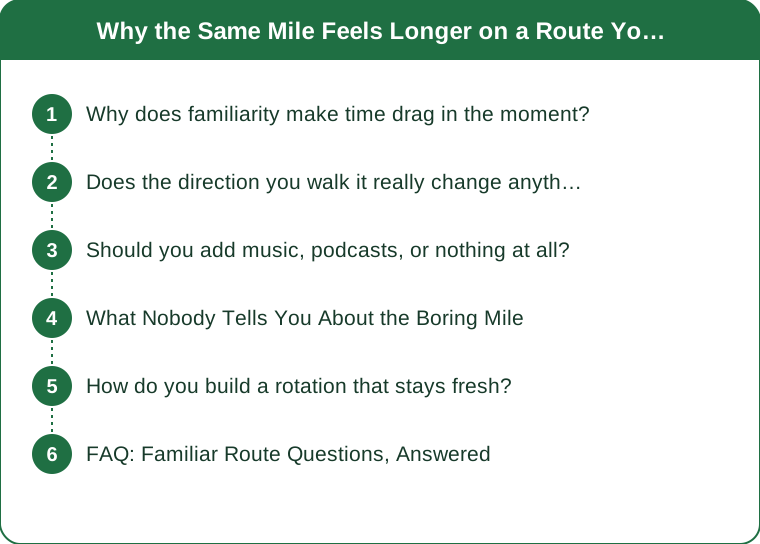
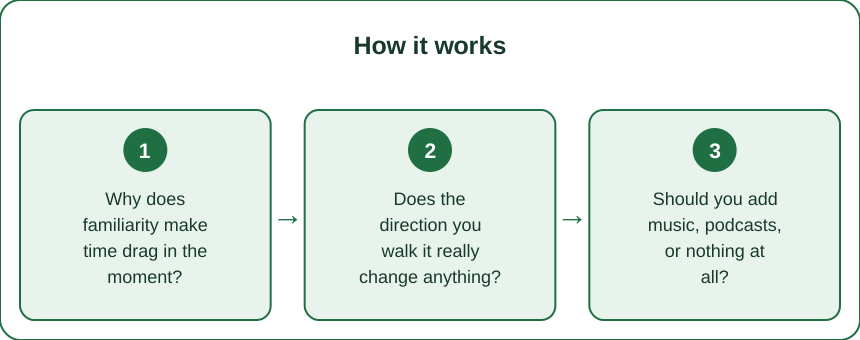
Why does familiarity make time drag in the moment?
Your sense of elapsed time is not a clock. It is largely reconstructed from how many distinct events your brain registered.
On a brand-new route, everything is an event — an unfamiliar corner, an unexpected hill, a dog you have not met. Your attention is fully occupied, and the walk passes quickly while you are in it, even though it later feels rich and long in memory.
On a route you know perfectly, there is almost nothing new to encode. Attention has nowhere to go, so it turns inward — onto your legs, your breathing, and the question of how much is left. That inward attention is precisely what makes time feel slow.
This is the same reason the drive to a new place feels longer than the drive home. The interesting wrinkle is that it flips for memory: the familiar walk feels long while you do it and short when you look back on it. The novel walk does the opposite.
Does the direction you walk it really change anything?
More than almost any other single change, and it is free.
Reversing your loop presents a completely different visual sequence. The hill you always climb at minute three now comes at minute nine. Houses you have only ever seen from one angle look unfamiliar. Your brain re-engages because the prediction it had built no longer applies.
People consistently report a reversed loop feeling shorter and more interesting for two or three weeks before it settles.
Other zero-cost variations in roughly descending order of effect:
- Change the start point. Same loop, entered from a different corner. Everything shifts.
- Change the time of day. A morning route and an evening route are different environments — different light, different people, different sounds.
- Add one block. A small detour that adds 200 yards resets the whole sequence and barely changes the distance.
- Walk one segment on the opposite side of the street. Trivial, and surprisingly effective on a straight stretch.
Should you add music, podcasts, or nothing at all?
Audio is the most common fix and it is not always the right one.
Podcasts and audiobooks pull attention outward, which makes the time pass. The cost is that you notice less of the walk itself, and for people who use their mile to think or decompress, that trade is a bad one.
Music with a steady tempo helps pace more than perceived time. It can make a mile feel more purposeful without occupying your attention entirely.
Silence is underrated in the transition season. Late summer into fall is when the soundscape actually changes — different birds, dry leaves, wind in a different register. There is more to notice than there was in July, if you let yourself notice it.
A reasonable approach: alternate. Audio on the days you need the mile to be easy, silence on the days you want the mile to be useful. Doing the same thing every time is part of what created the staleness.
What Nobody Tells You About the Boring Mile
The boring mile is often the most valuable one. Low novelty is exactly the condition under which your mind wanders productively. The walks where you solve something are rarely the scenic ones.
Boredom is not a signal to stop; it is a signal to vary. People quit daily walking habits at the point of staleness and conclude they lack discipline. What actually failed was the route, and the route is the easiest thing in the world to change.
Fitness improvements make routes feel shorter, not longer. If your familiar mile is feeling harder as well as longer, that is a different question — look at sleep, heat, and whether you are walking after a heavy meal.
Counting steps or checking a watch makes it worse. Every glance at elapsed time is a fresh reminder to your brain to track duration, which is the exact process that makes it drag. Put the watch away and let the route end when it ends.
The route does not need to be beautiful. It needs to be slightly unpredictable. A plain street you have not walked beats a lovely one you have walked 200 times.
How do you build a rotation that stays fresh?
The most durable setup is three or four routes of the same distance rather than one perfected route.
Build the set once. Map three loops of roughly a mile from your door. They do not need to be equally nice — variety is the point.
Rotate rather than choose. Deciding each day costs willpower. Monday-Thursday-Saturday on one, Tuesday-Friday on another, and so on. The decision is already made.
Reverse each of them periodically, which effectively doubles your set to six or eight distinct experiences.
Add one seasonal route. A path that is only good in autumn — a street with real leaf color, a park that empties out once school starts. It gives you something the other routes cannot offer for a few weeks a year, which is precisely the novelty you are short of.
Retire a route when it goes flat and bring it back in three months. It will feel new again.
FAQ: Familiar Route Questions, Answered
Am I actually walking slower on the familiar route?
Usually not, and it is worth checking once. Time the same loop on a fresh route and on the stale one. Most people find the pace is nearly identical and only the perception differs — which is useful to know, because it means the fix is variety, not effort.
Is it better to add distance or change the route?
Change the route first. Adding distance to a stale route often makes the drag worse, because you have extended the exact experience that was already feeling long. Once the route feels good again, add distance if you want to.
Does walking with someone else solve this?
Almost completely, and it is the strongest single intervention — conversation supplies continuous novelty and moves attention fully outward. The limitation is scheduling. Treat a walking partner as one option in the rotation, not as the whole plan, so the habit survives the weeks they cannot make it.
TL;DR:
- A familiar mile drags because your brain has almost nothing new to encode, so attention turns inward onto effort and time.
- Reversing your loop is the cheapest, most effective fix, and it lasts a couple of weeks.
- Vary the start point, the time of day, and add one block — small changes reset the whole sequence.
- Alternate audio and silence rather than defaulting to one; the boring mile is often the useful one.
- Build three or four routes and rotate on a schedule instead of choosing each day.
The mile has not gotten longer and you have not gotten lazier. You just ran out of things to notice, and that is a solvable problem in about five minutes of route planning.
See It in Motion
Seen here: High Waist Jogger Sweatpants with Pockets — shop it on bubblelime.com
Keep Reading
This article is for general informational and styling purposes only. Fit, sizing, and product availability may vary.