Why the Same Mile Feels Longer When the Air Turns Cold
Quick Answer: Cold air makes a familiar mile feel harder for four reasons: your muscles start colder and take longer to reach working temperature, cold air is drier and irritates the airway so breathing feels laboured, extra clothing adds weight and restricts movement, and reduced daylight shifts your perception of effort and time. None of these mean you are losing fitness. The mile typically feels normal again within ten days as your routine and clothing adjust, and the first five minutes are almost always the worst part.
You have walked this mile hundreds of times. It takes the same eighteen minutes it always did.
And this week it feels like a chore in a way it did not in August. The temptation is to read that as fitness slipping away over one changed week, which is almost never what is happening.

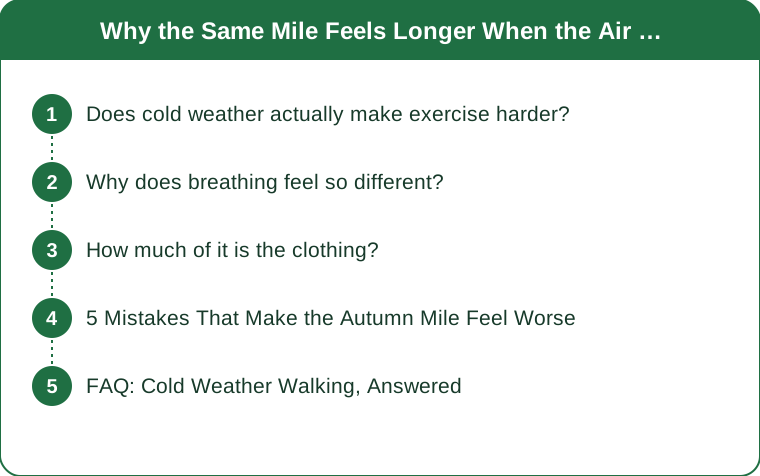
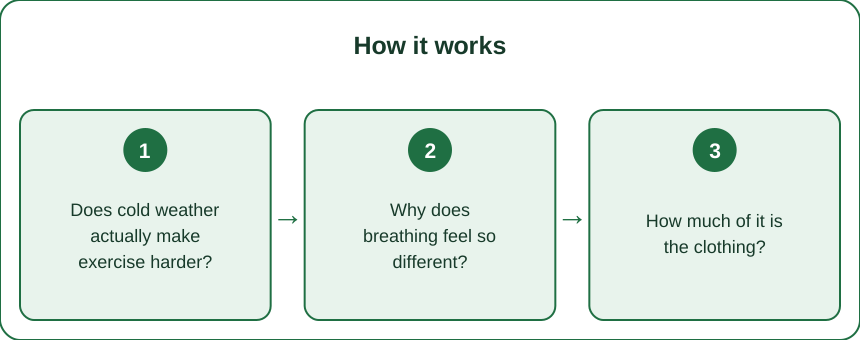
Does cold weather actually make exercise harder?
In the first ten minutes, yes, measurably. After that, no, and it often makes it easier.
Muscles work worse when cold. Muscle contraction speed and power output fall as muscle temperature drops, which is why every warm-up protocol exists. Starting a mile straight from a cold house on a cold morning means the first quarter is done with muscles that are not yet at working temperature, and it genuinely takes more effort to produce the same pace.
Your heart rate response is different. In cold conditions, blood vessels near the skin constrict to conserve heat, which raises blood pressure slightly and changes how blood is distributed. Heart rate at a given pace is often slightly lower in the cold rather than higher, which is one reason cold running feels effortful while the numbers look fine. The sensation and the measurement disagree.
Beyond the warm-up, cold is an advantage. Once you are moving, cold air removes body heat efficiently, so you do not accumulate the thermal load that makes summer efforts progressively harder. This is why endurance performance in cool conditions is typically better than in heat. The same mile you are struggling with in October is objectively easier than it was in July.
The practical consequence. The difficulty is front-loaded. If you can get past minute five, the rest is usually fine, which means the fix is about how you start rather than about fitness.
Why does breathing feel so different?
Because cold air is dry air, and your airway has to fix that before the air reaches your lungs.
Cold air holds much less moisture. Air at freezing carries a small fraction of the water vapour that warm summer air does. Your nose and airway warm and humidify incoming air, and in cold weather that job is much bigger.
The result is airway drying and irritation. Rapid breathing of cold dry air causes water loss from the airway lining, which triggers narrowing in susceptible people. This is the mechanism behind exercise-induced bronchoconstriction, which is more common and more pronounced in cold dry conditions and affects a meaningful share of people who have no asthma diagnosis at all.
What it feels like. A raw or scratchy throat, a dry cough that starts a few minutes in or shortly after finishing, a sense that you cannot get a satisfying breath, and tightness in the chest. This is very often mistaken for being out of shape.
What genuinely helps:
- Breathe through the nose for the first part of the walk. The nose humidifies far better than the mouth.
- A buff, scarf, or neck gaiter over the mouth traps exhaled moisture and warms the next breath. This is the most effective single intervention and it is not subtle.
- A longer, easier warm-up lets the airway adjust gradually rather than being hit with hard breathing from a standing start.
- If you get a persistent cough after cold exercise, that is worth mentioning to a doctor rather than pushing through. This is general information, not medical advice.

How much of it is the clothing?
More than people credit, and it is the easiest thing to fix.
Weight and restriction cost real energy. Extra layers, a heavier jacket, and heavier shoes all increase the metabolic cost of walking. The effect is small per item and it adds up, and the sensation of restricted arm swing or a jacket that fights your stride is disproportionate to the actual energy cost.
Most people overdress by one layer. A useful rule is to dress for about ten degrees warmer than the actual temperature, because you produce a lot of heat within a few minutes. If you are comfortable standing at the door, you will be too warm at minute eight, and being too warm produces sweat that then chills you.
The layering that actually works for a mile:
- A close-fitting base layer that moves moisture, in a synthetic or merino. Not cotton, which holds sweat against the skin.
- A light mid layer only if it is genuinely cold, not for a cool morning.
- A wind layer rather than an insulated one. Wind is what makes cool air feel cold, and a thin windproof shell changes the experience more than thick insulation.
- Extremities matter more than the trunk. Hands, ears, and neck are where cold is perceived most strongly. Gloves and a headband often replace an entire layer.
A note on the transitional weeks specifically. Late summer to autumn is the hardest period to dress for because mornings are cold and midday is warm. A layer you can remove and tie around your waist is not a compromise, it is the correct answer for this six-week window.
5 Mistakes That Make the Autumn Mile Feel Worse
1. Starting at full pace from a cold house. The single most common one. Muscles are at rest temperature, the airway is unprepared, and the first three minutes are consequently miserable. Walking the first three minutes deliberately slowly fixes most of the complaint people have about cold-weather walking.
2. Overdressing, sweating, then getting cold. Sweat in cold conditions is a real problem, because damp fabric conducts heat away from you rapidly once you slow down. This is why the walk feels fine and the last five minutes feel awful. Dress for how you will feel at minute ten.
3. Comparing pace to summer numbers. If you track your walk, the autumn version will often be slower in the first half and equal or faster in the second. Judging the whole thing by the first half creates a false story of lost fitness.
4. Moving the walk later and losing the cue. When mornings get dark and cold, people postpone the walk to a vaguer slot in the day, and the habit erodes. The cold is not what breaks the mile habit, the loss of a fixed time is. Keeping the same slot in worse conditions preserves the habit better than moving it to more comfortable conditions.
5. Treating the first bad week as a verdict. Acclimatisation to cold is real and takes roughly one to two weeks of repeated exposure. The perception of cold drops substantially over that window even though the temperature has not changed. Almost everyone who quits does it in week one.
FAQ: Cold Weather Walking, Answered
Why does the same walk feel so much harder in cold weather?
Mostly because your muscles start colder and take longer to reach working temperature, and cold dry air irritates the airway so breathing feels laboured. Both effects are front-loaded in the first five to ten minutes and fade once you are moving.
Is it bad to exercise in cold air?
For most healthy people, no. Cold dry air can trigger airway narrowing and coughing, which a scarf or buff over the mouth largely prevents. If you get chest tightness or a persistent cough afterward, mention it to a doctor. This is general information, not medical advice.
Should I walk slower in cold weather?
For the first three to five minutes, yes, deliberately. After that, hold your normal pace. Cold conditions actually favour endurance performance once you are warmed up, so an autumn mile is usually easier than a summer one in the second half.
TL;DR:
- The difficulty is front-loaded: cold muscles and an unprepared airway make the first five minutes genuinely harder.
- Cold dry air irritates the airway, and a buff over the mouth is the single most effective fix.
- Most people overdress by a layer, sweat, and then get cold at the end. Dress for ten degrees warmer than it is.
- Acclimatisation takes one to two weeks. Almost everyone who quits does it in the first week.
Walk the first three minutes deliberately slowly this week and see whether the mile still feels different.
See It in Motion
Seen here: Yoga Jogger Sweatpants with Pockets — shop it on bubblelime.com
Keep Reading
This article is for general informational and styling purposes only. Fit, sizing, and product availability may vary.