Why Walking Your Mile With Someone Changes the Pace You Would Have Picked
Quick Answer: Walking with someone shifts your pace toward theirs automatically through entrainment — an unconscious tendency to synchronize gait with a companion. Most people walk 5 to 15 percent slower in conversation but cover more total distance and are far more likely to show up. If the mile is for cardiovascular work, go alone. If it is for consistency and mood, go together.
Your usual mile takes 17 minutes.
Walk it with a friend and it takes 19, and you did not decide that at any point.

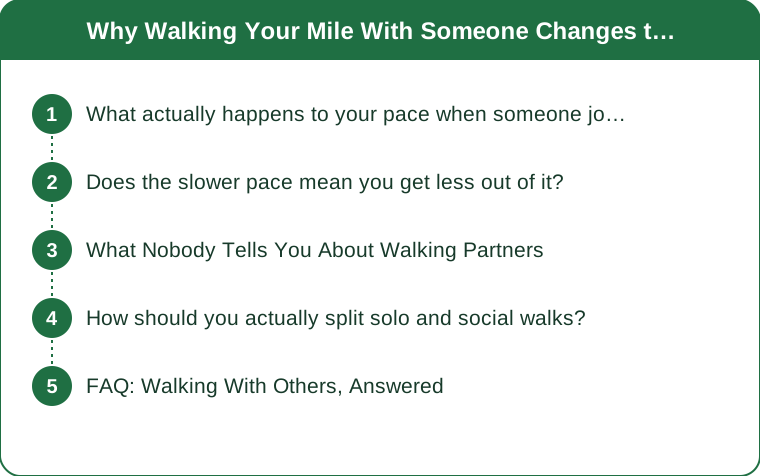
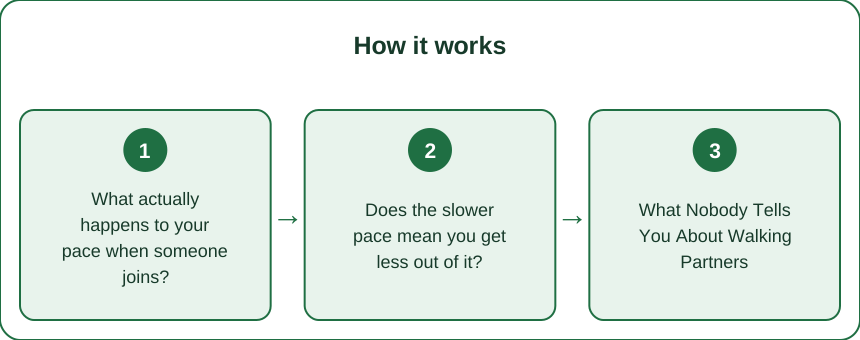
What actually happens to your pace when someone joins?
You synchronize, and you do it below conscious awareness.
Gait entrainment is automatic. People walking together fall into matched step timing within a minute or two, without discussing it. This happens with strangers as well as friends, which tells you it is not politeness — it is a motor coordination default.
The slower walker sets more of the pace than the faster one. Compromise pace does not land in the middle. It skews toward the slower person, because speeding up past your comfortable cadence takes more conscious effort than slowing down.
Conversation itself slows you. Talking changes your breathing pattern, and a breathing pattern optimized for speech is not optimized for effort. Most people drop pace measurably the moment they start a sentence.
You stop noticing your own effort. Solo walking gives you constant feedback on how hard you are working. Conversation occupies exactly the attention that monitoring would use.
Terrain response changes too. Walking alone, you naturally push a hill and ease on the flat. In conversation that variation flattens out — you hold one steady effort, which is a different physiological stimulus.
Does the slower pace mean you get less out of it?
For cardiovascular work, somewhat. For everything else, no — and often the opposite.
Intensity does drop. If your solo mile sits at a brisk pace that raises breathing rate noticeably, and the social version drops to conversational, you are training a lower zone. That is a real difference if cardiovascular fitness is the goal.
But total distance usually rises. The single most consistent finding in walking behavior is that people walking with a companion walk longer. A slower 1.6 miles beats a brisker 1.0 for total energy expenditure, and social walks routinely run long because stopping requires ending a conversation.
Adherence is the metric that actually decides outcomes. A walk you take five days a week at a moderate pace produces more benefit over a year than a brisk walk you take twice. Social commitment is one of the strongest predictors of showing up.
Mood effects are larger with company. The mood lift from walking and the mood lift from social contact are separate effects that stack. This is why a social walk on a bad day does more than a solo one at the same duration.
Perceived exertion drops for the same work. Distraction genuinely lowers how hard a given pace feels, which is why the social mile ends without the psychological negotiation the solo one sometimes needs.

What Nobody Tells You About Walking Partners
Height difference matters more than fitness difference. Stride length is largely a function of leg length. A 5-foot-2 walker and a 5-foot-10 walker at the same cadence cover very different ground, and the shorter walker ends up working considerably harder to hold the pace. This surprises people who assume mismatch means fitness mismatch.
Walking side by side is slower than single file. Two abreast on a narrow path means constant micro-adjustment for oncoming traffic, which breaks rhythm. On busy paths, the same pair covers less ground than either would alone.
Phone-call walking splits the difference. You get conversation without pace-matching, because there is no one to synchronize with. People on walking phone calls often hold near their solo pace while getting most of the distraction benefit.
Dogs are the exception that ruins the pattern. A dog walk is not a pace walk. Stops are frequent and unpredictable, and the intermittent stopping keeps heart rate from settling anywhere useful.
The third mile is where partners help most. For the first mile, solo motivation holds fine. The advantage of company shows up in the extension — the part of the walk you would have skipped.
How should you actually split solo and social walks?
Assign them different jobs instead of expecting one walk to do both.
Make one walk a week the effort walk, and do it alone. Push the pace enough that a full sentence is slightly awkward. This is where cardiovascular adaptation happens, and it is the one thing a social walk cannot deliver.
Make the social walks the volume walks. Longer, easier, conversational. This is where distance accumulates, and distance is what most weekly step targets are actually built on.
Use company for the walk you would skip. Bad weather, low motivation, dark early evenings — this is exactly where a scheduled walking partner outperforms willpower.
Do not try to make a social walk brisk. It produces mild resentment on both sides and rarely holds past the first quarter mile. If you need pace, say you are doing a fast one and walk it alone.
Seasonal note: as evenings darken through September and October, social walks become the more practical option for safety and motivation, and the effort walk migrates naturally to daylight hours. Plan for that shift before it forces itself on you.
FAQ: Walking With Others, Answered
How much slower is a conversational pace, really?
For most people, 5 to 15 percent. A 17-minute solo mile typically becomes an 18 to 19.5 minute social mile. The variation depends more on how much you talk than on who you walk with.
Does walking with someone faster actually improve my fitness?
It can, but not as reliably as people expect, because you are more likely to negotiate the pace down than to hold it. If you want the training effect from a faster partner, agree in advance that the pace is fixed and conversation is optional.
Is a walk still worth it if we barely move?
Yes, though for different reasons. Very slow walking with company delivers most of the mood and habit benefit and little of the cardiovascular benefit. That is a fine trade on a day when showing up is the win.
TL;DR:
- You synchronize pace with a companion automatically; the compromise skews toward the slower walker
- Social walks are 5 to 15 percent slower but usually longer, and adherence beats intensity over a year
- Mood benefits from movement and from company stack, which is why social walks lift a bad day more
- Keep one solo effort walk a week for cardiovascular work; make social walks the volume
- Height difference matters more than fitness difference when pairs feel mismatched
The mile you walk with someone is not a worse mile. It is a different one, doing a different job. Once you stop asking one walk to do both, both get better.
See It in Motion
Seen here: Super High Waist Embossed Yoga Leggings with Inner Pocket — shop it on bubblelime.com
Keep Reading
This article is for general informational and styling purposes only. Fit, sizing, and product availability may vary.